
Inflation-Proofing Your Portfolio: The Decisions That Matter (and the Ones That Don’t)
If your objective is real wealth (purchasing power), then inflation is not a side variable—it is the denominator of every return you earn.
Most investors understand this conceptually. Fewer implement it correctly.
This guide is for investors who already know the basics and want a precision framework: where inflation protection really comes from, where it usually does not, and how to convert that into portfolio policy.
Core principle: Inflation resilience is mostly an asset-allocation and liability-matching problem—not a ticker-picking problem.
Start with the metric that matters: real return
Nominal portfolio growth can hide purchasing-power decay. The approximation is straightforward:
Real return ≈ Nominal return − Inflation
The exact identity is:
1 + r_real = (1 + r_nominal) / (1 + π)
Where:
r_real= real returnr_nominal= nominal returnπ= inflation
Why this matters in implementation
A 7% nominal return during 5% inflation is not “good equity performance”; it is roughly 1.9% real. Your risk budget, withdrawal assumptions, and contribution plans must be calibrated to real outcomes, not nominal headlines.
The decisions that matter most
1) Set your inflation beta at the total-portfolio level
Think in terms of regimes:
- Disinflation / stable inflation: growth assets + duration typically work.
- Inflation surprise: long duration is often the weak link; real assets and pricing-power equities matter more.
A practical implementation stack:
| Sleeve | Typical role in inflation regimes | Implementation notes |
|---|---|---|
| Global equities (quality + pricing power) | Partial long-run inflation pass-through via earnings | Prefer firms with pricing power, low capital intensity, resilient margins |
| TIPS / inflation-linked bonds | Direct CPI linkage in principal | Best for liability matching in local currency |
| Commodities / broad real assets | Strong sensitivity to inflation shocks | Use as shock absorber, not growth engine |
| Real estate / infrastructure | Income streams can reset with inflation (lagged) | Distinguish regulated vs market-price reset dynamics |
| Nominal gov bonds (duration) | Deflation hedge, recession ballast | Useful, but size carefully when inflation risk is dominant |
Actionable takeaway: Size your inflation-defense sleeves at the portfolio level first; security selection is secondary.
2) Match assets to your personal inflation basket
Headline CPI is an index average. Your household inflation may be structurally different (e.g., healthcare, education, rent-heavy, or travel-heavy).
Build a simple household inflation map:
| Spending category | Weight in your budget | Inflation sensitivity | Portfolio implication |
|---|---|---|---|
| Housing | 35% | Medium–High | Consider REITs/infrastructure exposure; maintain liquidity buffer |
| Healthcare | 15% | High, sticky | Increase real-return target and safety margin |
| Education/childcare | 10% | High | Ring-fence medium-term liabilities in inflation-linked assets |
| Transport/energy | 10% | Cyclical spikes | Small commodity sleeve can reduce surprise risk |
| Discretionary | 30% | Variable | Keep flexible spending as risk shock absorber |
When your liability profile is known (tuition in 8 years, retirement withdrawals in 20+ years), inflation-proofing becomes a cash-flow hedging problem—not a macro guess.
3) Control duration risk explicitly
Inflation shocks usually hurt long-duration nominal bonds via repricing of real yields and inflation expectations.
Decision framework:
- Keep nominal duration for recession/deflation hedging.
- Add inflation-linked duration (TIPS) for purchasing-power protection.
- Avoid accidental duration concentration from overlapping funds.
A quick diagnostic:
If expected inflation rises by 1%, how much does total portfolio expected real return change?
If you cannot answer that within a rough range, your inflation risk is not yet governed.
4) Rebalance by rule, not by narrative
Inflation regimes create big relative moves across sleeves. Without disciplined rebalancing, portfolios drift into concentrated macro bets.
A robust policy:
- Define target bands (e.g., ±20% relative band around each sleeve target).
- Rebalance on threshold breach or periodic schedule (quarterly/semiannual).
- Minimize tax friction by using contributions/withdrawals first.
This captures mean reversion and prevents “story chasing” after inflation spikes.
5) Keep implementation costs lower than expected hedge benefit
Inflation hedging can be expensive if overengineered. High turnover, complex alternatives, and tax leakage can erase real-return gains.
Use this filter:
| Question | Green light | Red flag |
|---|---|---|
| Does this sleeve improve expected real drawdown profile? | Yes, under explicit scenarios | “It should work” without quantified scenarios |
| Is carry/cost transparent? | Low-cost ETF/fund, clear mechanics | Opaque fee stack, hidden roll costs |
| Can I maintain it behaviorally? | Simple, rules-based | Requires frequent tactical calls |
The decisions that usually don’t matter (as much as people think)
1) Over-optimizing tiny sleeve weights
Debating 4% vs 6% commodities matters less than whether your total portfolio has coherent inflation-risk architecture.
2) Chasing one “inflation hero” asset
No single asset dominates across all inflation episodes. Different inflation shocks (demand-led, supply-led, wage-price, policy-driven) favor different exposures.
3) Macro prediction as a primary process
You do not need to forecast next year’s CPI print to build resilience. You need a portfolio that survives a distribution of inflation outcomes.
4) Confusing nominal income with real income
A 5% bond coupon can still be a negative real return. Focus on after-tax, after-inflation cash flow.
Scenario matrix: what tends to work when
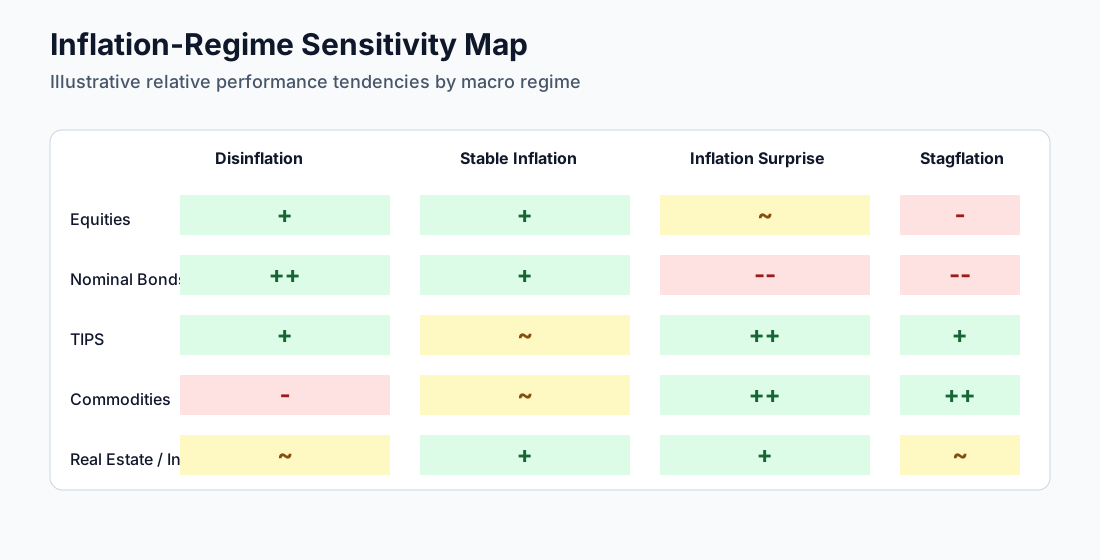
| Macro regime | Equities | Nominal Bonds | TIPS | Commodities | Real Estate/Infra |
|---|---|---|---|---|---|
| Growth up, inflation stable | ✅ | ✅ | ➖ | ➖ | ✅ |
| Growth down, disinflation | ❌ | ✅✅ | ✅ | ❌ | ➖ |
| Growth up, inflation surprise up | ➖ | ❌❌ | ✅✅ | ✅✅ | ✅ |
| Stagflation | ❌ | ❌❌ | ✅ | ✅✅ | ➖ |
Legend: ✅✅ strong relative tailwind, ✅ modest tailwind, ➖ mixed/neutral, ❌ headwind.
A practical blueprint (example ranges, not personalized advice)
For a long-horizon investor with moderate risk tolerance:
| Sleeve | Example range |
|---|---|
| Global equities (quality/value blend) | 45–60% |
| Nominal bonds (short/intermediate bias) | 15–25% |
| TIPS / inflation-linked bonds | 10–20% |
| Real assets (commodities + REITs + infra) | 10–20% |
| Cash / near-cash optionality | 3–8% |
Implementation notes:
- Keep equity exposure globally diversified; avoid single-country inflation narratives.
- Prefer systematic factor tilts over discretionary macro tilts.
- Treat commodities as a convex hedge sleeve, sized modestly.
Real-return arithmetic: a quick visual
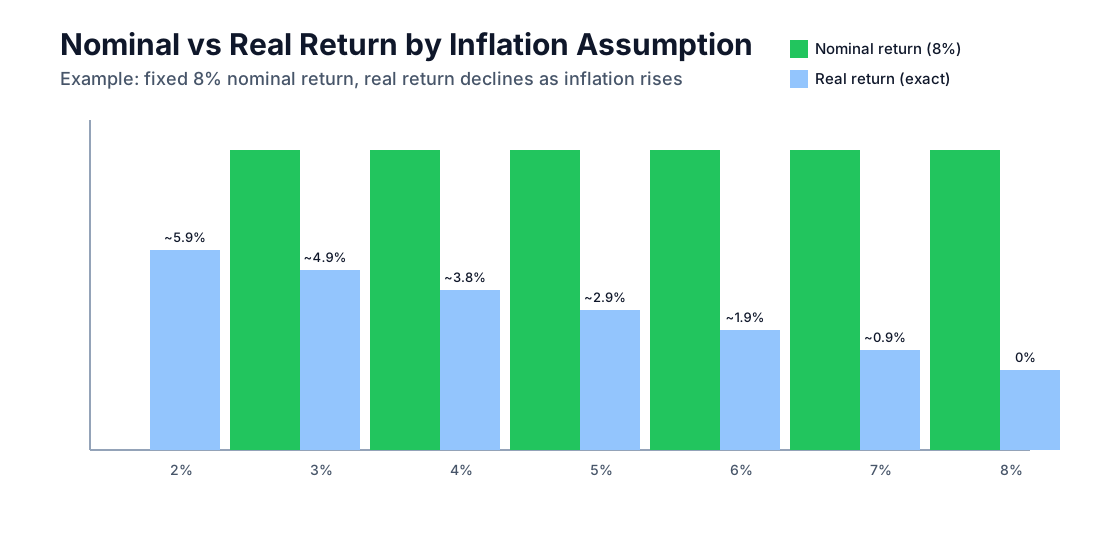
Even modest changes in inflation assumptions can dominate optimization tweaks in fund selection.
Governance checklist for advanced investors
- I have a documented real-return target (not only nominal).
- I can estimate portfolio behavior under +1% and +2% inflation surprises.
- My inflation-linked sleeve size is policy-driven, not headline-driven.
- I rebalance via predefined rules.
- I evaluate outcomes net of taxes, fees, and inflation.
- My household liability calendar is mapped to asset buckets.
If you cannot check at least 5/6, your inflation process is likely under-specified.
Bottom line
Inflation-proofing is less about finding perfect assets and more about making a handful of high-impact structural decisions:
- Define success in real terms.
- Build explicit inflation-sensitive sleeves.
- Match assets to liabilities and spending reality.
- Control duration and rebalance systematically.
- Keep costs and complexity below expected benefit.
Everything else is mostly optimization noise.
If you want to pressure-test your portfolio against inflation regimes, track sleeve-level allocations, and monitor concentration risk over time, use a transparent process and tooling that keeps the focus on decision quality, not prediction theater.