
Cash Drag vs. Dry Powder: How Much Cash Should You Really Keep (and Why)?
Cash is the only asset class that is simultaneously:
- a guaranteed nominal anchor,
- a guaranteed real loser over long inflationary horizons,
- and a high-value option during dislocations.
That tension is the core of the cash-allocation problem.
Thesis: The right cash balance is not a static “rule of thumb.” It is the output of your liquidity horizon, drawdown tolerance, rebalancing policy, and opportunity set.
Cash has three jobs (and mixing them creates bad decisions)
Treat “cash” as three separate buckets:
| Bucket | Purpose | Typical horizon | Should it be invested? |
|---|---|---|---|
| Operating cash | Bills, payroll, near-term spending | 0–6 months | No |
| Safety reserve | Income shock / emergency resilience | 6–24 months | Mostly no |
| Strategic dry powder | Opportunistic deployment in sell-offs | Event-driven | Yes, by policy |
If you combine these into one account, you either:
- under-protect your household/business, or
- over-allocate to idle cash and accept persistent cash drag.
The math: quantify cash drag before you moralize about it
Expected real return on cash ≈ cash yield − inflation − taxes on interest
In other words: start with your cash yield, then subtract inflation, then subtract taxes on that interest income. For many investors, the final number is low or negative.
Expected portfolio return = (cash weight × expected cash return)
                         + ((1 − cash weight) × expected risky-asset return)
This just says your portfolio return is a weighted average of your cash sleeve and your invested sleeve.
Cash drag from extra cash ≈ extra cash weight × (expected risky return − expected cash return)
This means the opportunity cost of holding more cash equals: how much extra cash you hold multiplied by the return gap between risky assets and cash.
Example:
- If risky assets are expected to earn 6% real and cash is expected to earn 0% real,
- then each extra 10% kept in cash costs about 0.60% expected real return per year.
Over long horizons, that compounding gap becomes large.
But dry powder is not free alpha either
Many investors assume cash automatically creates upside during crashes. It does only if you have a deployment rule.
Without one, dry powder usually becomes:
- permanently idle,
- emotionally “too valuable to spend,”
- and eventually reclassified as “safety cash” after the opportunity passes.
Deployment policy example
| Trigger (from peak) | Cash tranche deployed | Destination |
|---|---|---|
| -10% broad equity drawdown | 20% of strategic dry powder | Global equity ETF sleeve |
| -20% | Additional 30% | Equity + small-cap/value tilt |
| -30% | Additional 30% | Core risky allocation |
| -40% | Final 20% | Rebalance to strategic targets |
No trigger rules = no reliable conversion of optionality into return.
The decisions that matter most
1) Size cash from liability horizon, not market feelings
A practical stack:
- Tier 1 (0–6 months spending): pure liquidity.
- Tier 2 (6–24 months): high-liquidity, low-volatility instruments.
- Tier 3 (strategic): explicit policy cash for opportunistic rebalancing.
The strongest input is not valuation, punditry, or fear index readings. It is how long you can remain solvent and behaviorally stable without forced selling.
2) Define a minimum survival cash floor
Your floor should cover non-discretionary outflows net of reliable inflows:
Cash floor = (Essential monthly outflows - reliable monthly inflows) × months_of_coverage
Where months_of_coverage can vary by income stability:
| Income profile | Suggested coverage band |
|---|---|
| Highly stable salaried income | 6–9 months |
| Variable bonus/commission income | 9–15 months |
| Self-employed / cyclical income | 12–24 months |
| Retiree drawing from portfolio | 18–36 months (cash + short-duration ladder) |
This is where most “how much cash?” answers should start.
3) Separate defensive cash from offensive cash
Use two labels in your IPS (investment policy statement):
defensive_cash: never deployed into risk assets unless personal emergency passes.offensive_cash: deployable under pre-committed market rules.
This separation prevents one of the most common process failures: accidentally spending your emergency reserve to “buy the dip,” then being forced to sell later for real-life expenses.
4) Rebalance with cash as a shock absorber
In volatile markets, cash is not only a return drag. It is also a rebalancing asset that can lower turnover and tax friction.
Use this order of operations:
- Direct new contributions to underweight sleeves.
- Use offensive cash if breach thresholds hit.
- Sell overweight risky assets only if needed after steps 1–2.
This can improve net implementation quality even if headline returns are slightly lower in calm markets.
5) Match cash instrument to objective
Not all “cash-like” vehicles are equivalent.
| Instrument | Liquidity | Mark-to-market volatility | Credit/structural risk | Best use |
|---|---|---|---|---|
| Bank deposits | High | None (nominal) | Bank/guarantee limits | Operating cash |
| T-bills / short sovereigns | High | Low | Sovereign duration/roll | Safety + tactical |
| Money market funds | High | Very low | Sponsor/underlying quality | Operating + reserve |
| Ultra-short bond funds | Medium-High | Low-Medium | Spread + duration | Reserve extension (not true cash) |
Instrument mismatch is a hidden source of crisis-time regret.
The decisions that usually don’t matter much
1) Optimizing for +20 bps on idle cash
Micro-optimizing yield often adds operational complexity while barely changing long-run real outcomes.
2) Using a single universal percentage rule
“Always hold 5% cash” is too rigid across different human balance sheets, job risk, and withdrawal profiles.
3) Calling short-term macro with your liquidity bucket
Liquidity policy should be robust to being wrong. If it depends on precise rate and equity forecasts, it is speculation, not liquidity management.
4) Confusing comfort with policy
“Cash helps me sleep” is valid—but it should be translated into an explicit cost (expected return give-up) so the choice is intentional.
Visual: optionality value vs compounding cost
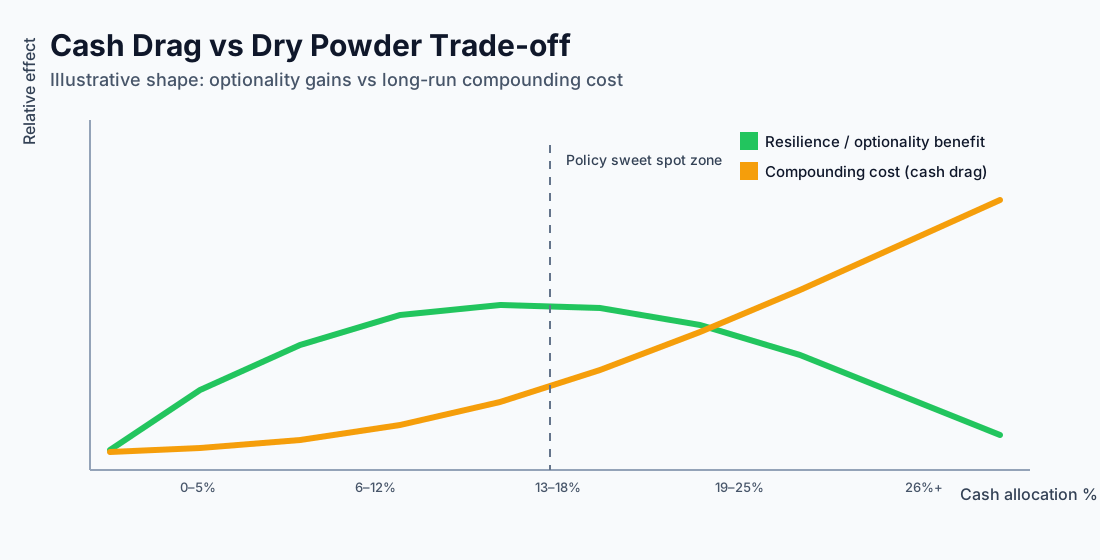
Interpretation:
- As cash % rises, drawdown resilience and optionality improve initially.
- Beyond a point, compounding cost accelerates and overwhelms marginal resilience gains.
Scenario matrix (illustrative)
| Regime | Low cash (0–5%) | Medium cash (6–15%) | High cash (16%+) |
|---|---|---|---|
| Steady bull market | Best compounding | Slight drag | Significant drag |
| Fast correction / V-shape | Forced seller risk if no buffer | Good rebalance capacity | Good optionality, but timing risk |
| Prolonged bear market | Vulnerable if income shock occurs | Better resilience | Strong resilience, lower long-run CAGR |
| High inflation + stable growth | Better if invested in productive assets | Balanced | Real erosion of purchasing power |
Quant snapshot: expected CAGR vs cash weight
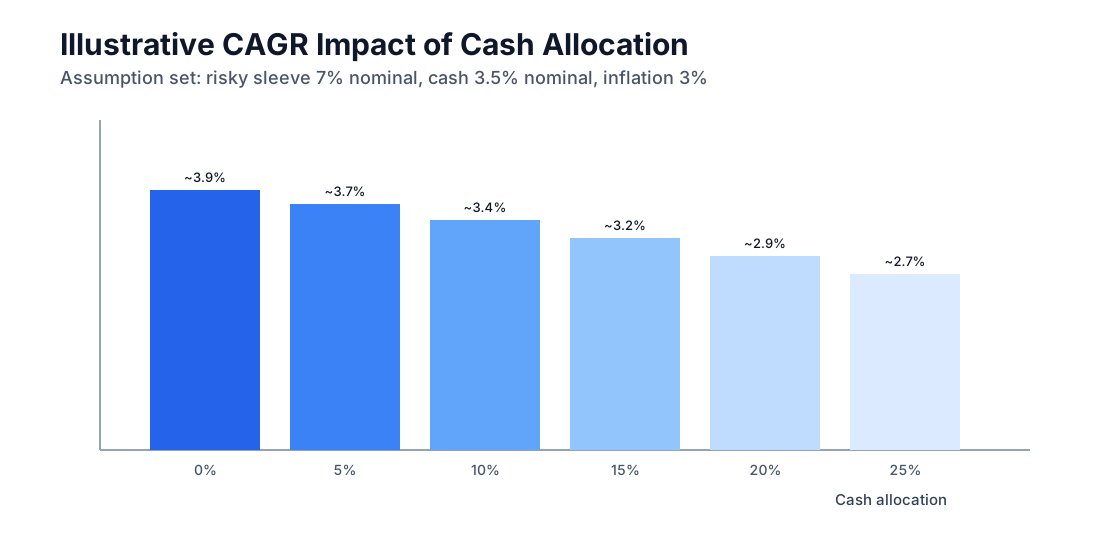
Even when assumptions are conservative, expected CAGR tends to step down as structural cash allocation rises. This does not mean "minimize cash at all times"—it means treat cash as an intentional insurance budget with a known expected cost.
A policy blueprint (example ranges)
<span style="font-size: 1.05em;"><strong>Not personal advice</strong>; this is a portfolio-design template.</span>
| Investor type | Defensive cash | Offensive dry powder | Total cash target band |
|---|---|---|---|
| Stable-income accumulator | 4–8% | 2–5% | 6–12% |
| Variable-income professional | 8–15% | 3–7% | 11–22% |
| Early retiree / FIRE drawdown | 12–24% | 2–6% | 14–30% |
| Entrepreneur with cyclical cash flows | 12–30% | 0–5% | 12–35% |
Then define:
- max drift bands,
- deployment triggers,
- refill rules after deployment,
- tax-aware rebalancing sequence.
Governance checklist
- My cash policy distinguishes operating, defensive, and offensive buckets.
- I know my cash floor in months and in currency terms.
- I have pre-committed drawdown triggers for deploying dry powder.
- I have refill rules after deployment (e.g., rebuild over 6–12 months).
- I track cash drag as an explicit annual “insurance premium.”
- I reassess policy when liabilities or income stability change.
If you cannot tick at least 5/6, your cash policy is likely narrative-driven.
Bottom line
The right question is not: “Is cash good or bad?”
The right question is: “What cash level maximizes portfolio survival and decision quality without unacceptable long-run compounding drag?”
For most advanced investors, the optimal answer is a policy range, not a point estimate. Treat cash as a governed portfolio sleeve with explicit purpose, and it shifts from accidental drag to deliberate optionality.